Introduction
The word Tantra often creates confusion and curiosity. Many people associate Tantra only with mystical rituals or misunderstood practices, but the true essence of Tantra is far deeper. In ancient Indian spirituality, Tantra represents a powerful path of transformation that combines mantra, meditation, ritual, and inner awakening.
Two terms that frequently appear in spiritual discussions are Vedic Tantra and Traditional Tantra. While they are related, they come from different historical developments and spiritual approaches. Understanding the difference helps seekers follow the path that aligns best with their spiritual goals.
In this article, we will explore the meaning, origins, principles, and practices of Vedic Tantra and Traditional Tantra, and reveal the truth behind the misconceptions.
What is Vedic Tantra?
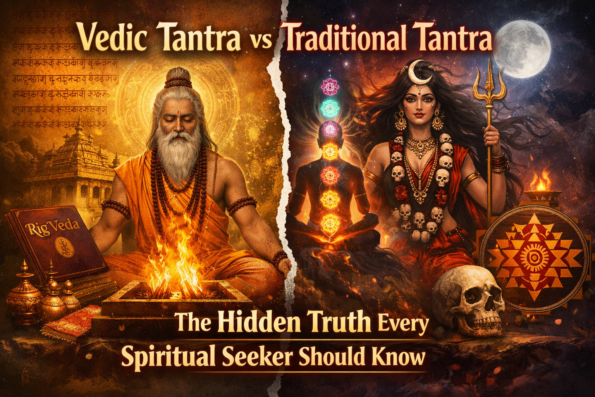
Vedic Tantra refers to tantric practices that are closely aligned with the Vedic spiritual tradition. These practices integrate Vedic mantras, sacred rituals, meditation, and disciplined spiritual living.
In Vedic Tantra, the focus is on spiritual growth through:
- Sacred Vedic mantras
- Ritual worship (Yajna and Puja)
- Meditation and self-discipline
- Awakening divine consciousness
The philosophy of Vedic Tantra emphasizes purity, devotion, and inner transformation. It treats Tantra not as a mysterious or secretive practice but as a sacred spiritual science rooted in Vedic wisdom.
Key Characteristics of Vedic Tantra
- Rooted in Vedic scriptures and traditions
- Uses Vedic mantras and rituals
- Focus on spiritual elevation and self-realization
- Emphasis on discipline and purity
- Often practiced under guidance of a spiritual teacher
Vedic Tantra is generally considered a safer and more structured spiritual path, making it suitable for sincere seekers who want to deepen their spiritual journey.
What is Traditional Tantra?
Traditional Tantra refers to the broader system of Tantric teachings that developed after the Vedic period, especially within Shaiva, Shakta, and Buddhist traditions.
Unlike strictly Vedic practices, traditional Tantra often includes esoteric rituals, symbolic practices, and secret teachings that are transmitted from guru to disciple.
Traditional Tantra focuses on awakening Shakti (divine energy) within the human body and using that energy for spiritual transformation.
Key Characteristics of Traditional Tantra
- Originates from Tantric scriptures known as Tantras
- Strong emphasis on Shakti (divine feminine energy)
- Includes mantras, yantras, mudras, and rituals
- Uses symbolic and mystical practices
- Often taught through initiation by a guru
Many forms of traditional Tantra aim at awakening Kundalini energy, which is believed to reside at the base of the spine and rise through the chakras during spiritual awakening.
Core Principles of Tantra
Despite their differences, both Vedic Tantra and Traditional Tantra share several important principles.
1. Divine Energy Exists Within Every Being
Tantric philosophy teaches that divine consciousness is present within every human being. Spiritual practices help awaken that hidden power.
2. The Universe is a Manifestation of Consciousness
Tantra views the universe as an expression of cosmic energy (Shakti) interacting with pure awareness (Shiva).
3. Spiritual Transformation Through Practice
Both systems use tools such as:
- Mantra (sacred sound)
- Yantra (sacred geometry)
- Meditation
- Ritual practices
These practices aim to expand awareness and achieve spiritual liberation.
Vedic Tantra vs Traditional Tantra
Here is a simple comparison to understand the differences.
| Aspect | Vedic Tantra | Traditional Tantra |
|---|---|---|
| Origin | Rooted in Vedic tradition | Based on Tantric scriptures |
| Focus | Spiritual discipline and purity | Awakening divine energy |
| Practices | Vedic mantras, rituals, meditation | Mantra, yantra, chakra, Kundalini |
| Teaching style | Scriptural and structured | Often secret and initiatory |
| Goal | Spiritual elevation and self-realization | Energy awakening and transformation |
Although their approaches differ, both ultimately aim to expand human consciousness and connect with the divine.
Common Misconceptions About Tantra
Over time, Tantra has been misunderstood and misrepresented. Several myths have distorted its true meaning.
Myth 1: Tantra is only about rituals
In reality, Tantra is a complete spiritual philosophy that includes meditation, ethics, and inner awareness.
Myth 2: Tantra is related to black magic
Authentic Tantra focuses on spiritual awakening and transformation, not harmful practices.
Myth 3: Tantra is only about physical practices
True Tantra is primarily about energy awareness, meditation, and consciousness expansion.
The Spiritual Purpose of Tantra
The ultimate goal of Tantra is self-realization. Through disciplined practices, seekers gradually dissolve the illusion of separation and realize their unity with universal consciousness.
Tantra teaches that spiritual awakening does not require rejecting the world. Instead, it encourages integrating spirituality into everyday life.
By transforming awareness, Tantra helps individuals:
- awaken inner energy
- develop deeper spiritual insight
- cultivate compassion and wisdom
- experience divine consciousness
Which Path Should a Seeker Follow?
Choosing between Vedic Tantra and Traditional Tantra depends on personal inclination and guidance from a qualified teacher.
Many spiritual seekers begin with Vedic-based practices because they are structured and widely accessible. Over time, some may explore deeper Tantric teachings under proper guidance.
The most important aspect is sincerity, discipline, and respect for the spiritual tradition.
Conclusion
Vedic Tantra and Traditional Tantra are two interconnected streams of a profound spiritual tradition. While their methods may differ, both aim to awaken the divine potential within human beings.
Vedic Tantra emphasizes purity, discipline, and Vedic wisdom, while Traditional Tantra explores mystical practices and energy transformation.
When practiced with proper understanding and guidance, Tantra becomes a powerful path of spiritual growth, self-discovery, and enlightenment.